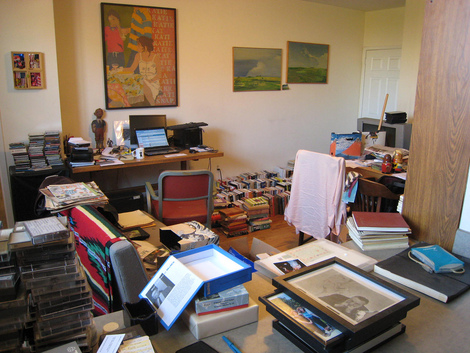
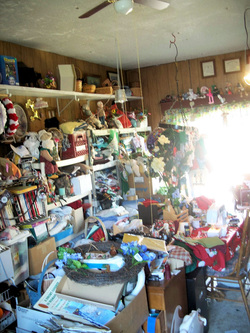
Getting organized can be tedious and overwhelming when you are alone and without support of your partner, family and or roommates, who don't want to be your cohort in the organizing adventure. Organizing a shared space with an unwilling partner can block the road to YOUR ORGANIZED world. Most commonly I hear that a spouse, partner, family member or roommate wants to get organized but the other half is just fine in their clutter comfort. This tends to be difficult and worrisome for the person who wants freedom and escape from clutter and disorganization. Why does clutter come between people? Well some people realize that the outer is a reflection of the inner and want to have an organized system to help them stay focused and productive. Other people push clutter in your face and are just plain old “self-centered”, not aware of their surroundings and or other's feelings. The person creating the disorganization and mess cannot see the demise of their counterpart. Or could it be they thrive on clutter and actually feel comforted? Are people REALLY comfortable with clutter? Not usually, but on some level if a person grew up in a cluttered environment they may not think twice about living the same way as was their home of origin. Other people who tolerate clutter mayhem well, may suffer from mental health challenges such as depression, anxiety, ADHD, ADD and or Obsessive Compulsive challenges. The divide, amongst people who share space, in housekeeping styles, is what a lot of partnerships fight about. Most people who cohabitate or who share space fight about money, housekeeping, moral issues, how to raise children/pets, and sex (if that is in the equation). Housekeeping, let's face it is tedious, but when clutter has run rampant it may become dangerous, harmful to health and downright unbearable for a person who likes order and neatness. One person may feel like they are king, on their "junk" pile, while the other a drowning person. So what to do when two or more people in a space are at odds with each other? Well what most civilized groups tend to do is compromise. But how do you compromise on clutter and chaos? The same way emotionally intelligent people solve conflict, you discuss it, find out what common ground there is (no pun intended), and you make a plan that suits both of you. The best way to discuss a difficult situation is to use assertive language. Assertive language style goes like this. YOU: I feel______________(adjective feeling words) i.e. hurt, overwhelmed, confused, disappointed, let down, unheard, stepped on etc.... when________________(describe situation) i.e. there are piles of stuff in corners, the garage is overtaken by your unfinished projects, when I can't see the countertop, when dishes are left in the sink, when the house if not kept up etc.... and then the finale......_______________________(validation, so they hear the feelings) i.e. and I love you so much, and you are such a great partner, and so creative and so loveable and I appreciate this and that about you, you’re a fun roommate etc.... The reason for the switch from the "I feel" statement and the "situation" statement to the sweet "validation" statement is that ideally the other person will hear your feelings and respond accordingly. There are no guarantees, if you become highly assertive, the other person will respond appropriately. That doesn’t mean that you lower your communication style, becoming aggressive, passive aggressive or passive, it just means you will probably have to learn how to have rules about your world and boundaries to protect it. When you discuss situations that bring on contention between you and others, in an assertive manner, you will feel more confident and justified in your approach, and also create expectations for an assertive response. When the other person comes back at you with aggression, passive aggressive stances, and or ignores you and you feel defeated keep going with the above assertive language. If the other person continues to use a non-assertive method of communication even though you have shared deep and dark feelings, and have validated them, it is time to realize they do not care about your feelings and or working on a better partnership. Your next step may be to seek counseling, individual and or family, get coaching with an experienced life coach or take a break from the situation through separation until the other person will hear you, and make the necessary changes for the partnership to resume comfortably for both of you. Remember when you share space….the meaning of share is important! Marla Stone Professional Organizer Retired LCSW www.i-deal-lifestyle.com [email protected]
3 Comments
I was honored to speak at the Mental Health Association of San Francisco's Hoarding and Cluttering Convention. My talk on "How To Organize Your Space with a Feng Shui Template" was welcomed by the audience. They seemed to enjoy it, as much as I did, since it focused off the clutter, and more on fun and easy solutions to clearing the path.
Most educators at the convention concurred that many people with clutter and hoarding challenges do not go to therapy. Most likely because they don't see their clutter as a problem. Also, something to do with attachment issues, which means the stuff they collect is friendly and fuzzier then most people, and they have no intention of getting rid of a thing. The stuff issue is just to personal and painful.There were Professional organizers and consumers at this convention working on all kinds of solutions for over-collecting and accumulating. The researchers attending indicate it is bio/psycho/social challenge, which means genetic, psychological and societal. Hoarding disorder and Obsessive Compulsive Disorder may factor in to the more serious cases. Once the objects, stuff and items build up into a barricade, and the people living in the space can barely move, creating psychosis, depression, anxiety, fire hazards, and possibly even death it becomes dangerous. You can read more about these challenges in a previous article at http://www.i-deal-lifestyle.com/1/post/2011/09/do-i-have-ocd.html Social workers, marriage and family therapists, psychologists, psychiatrists and educators help with hoarding and mental health challenges, but the kindness and compassion, and physical aspect of going into someone's home to transform it is usually done by professional organizers. The boundary issues prohibit so much of what mental health practitioners provide and offer. Anyone who wants to help with a hoarding situation will want to roll up their sleeves and pitch in. When that is not comfortable for a practitioner / family member / or friend then the helping is better left to a professional organizer with a mental health background. You either have the knack to help others get organized and to have resolve in their lives, or you don't. There is no in-between in being a professional organizer. Getting organized is hard work, and takes tenacity, thoughtfulness and a planned strategy for both the organizer, and the person with hoarding and cluttering challenges. For people with clutter and hoarding challenges other people, who get close to them, may pose unsafe possibilities (people wanting to get rid of their charged items, judgment, abuse, removal from their home). The objects start to take life, meaning and then a relationship is formed. Also things that are collected may hold memories, ideas, thoughts and images of a time, person, place. The mind has now made a simple ice cream wrapper a time spent on the beach with a person's absent son, brother, husband or friend. It is a seriously isolating. It is seriously challenging. It is seriously difficult to stop. I have four very close friends and family members who suffer with their barricades, and the one common link I found is a broken and damaged relationship with their fathers. I started to talk to clients I work with, and it may be a greater possibility that the paternal modeling is essential in future organizing skills. Marla Stone, Author, Professional Organizer, Decor and Feng Shui Idealist, Lifestyle Changer www.i-deal-lifestyle.com 949-709-7000 Hoarding, collecting, getting organized and staying organized seem to be very popular subjects these days. I subscribe to several magazines and each and every month there is at least one article about being or getting organized. Most magazines are focused heavily on organizing one’s self, home or office. The television shows, on collecting and hoarding, portray extreme cases, actually making you feel ill watching them. Hoarding seems to be happening in epidemic proportions. So are you a collector or a hoarder and what is the difference? The answer is you cannot be hoarding if you have not collected, but you can collect and not hoard, so they are separate terms. Hoarding is a negative behavior if the hoarding is creating an impoverished way of life. Collecting seems to be a much kinder way to look at the situation, yet it is the necessary key element and beginning act to hoarding. When someone has boxes, papers, collectibles, food products, gifts, animals and so much stuff it takes up their precious living space, until the point that they cannot even enjoy or use the stuff, it called Impoverished Wealth. You have so much stuff, stuffed in your home, you cannot even use or enjoy it. The money or time you spent collecting items, has now taken up your space for living, moving about and enjoying a fulfilled lifestyle. Collecting, on the other hand, if done as a hobby or for a purpose and does not turn into cluttered mess, can be quite enjoyable. I enjoy collecting art, artistic objects, books on decorating, Feng Shui, alternative health and herbal medicine. I have a place for everything. When I buy more then I have space for, I eliminate something and replace it with something I like better. The minute your stuff starts to fill entire rooms, garages and walk-ways you are probably collecting and hoarding too much stuff. Whatever is eliminated may go to family, friends or sold on Ebay.com or esty.com. Anything left from your purging can go to charity. Your taste in fashion and design changes about every 7-8 years, and so go to Town and get some new stuff, go ahead and collect and keep it around until it doesn’t please you aesthetically any longer. People who have a very difficult time letting go of “things”, even when the “things” are making their life impossible to enjoy, and who cannot stop bringing home “things”, that serve no purpose for them, are considered to be hoarding. I don’t like to call people “hoarders”, because they are not “hoarders”, they are PEOPLE who have a hole inside of them and they think they can fill up that hole with stuff. Generally I have found that people with collecting and hoarding behaviors have lost something, and they have not processed loss, therefore they have found some “things”, “items” and food or pets, which give them pleasure and fulfillment for that very moment. People with collecting and hoarding behaviors are generally the kindest, most loving and considerate people that live in our world. They have been wounded and they are licking their wounds with things that make them feel warm and fuzzy inside. I see people barricade themselves into their homes, and that is exactly what all the boxes, books, papers and stuff is, a barricade. People that create a barricade are people who have been wounded and hurt. The barricade is a sign that they have been violated, and had their boundaries crossed by intrusive, often times violent, and disrespectful people. Some people who hoard and barricade learned it from their childhoods, and many, at first, spent years working on being clean and orderly, yet ultimately fell into the same mire as their parents. When someone, with no background in helping people with collecting and hoarding behaviors, gets involved and starts to clean up or take power and control of the “things”, most people, that suffer from their collecting and hoarding, become VERY upset. I have seen people become very hypervigilant, depressed, angry, violent and sometimes psychotic if their property is even slightly disrupted. But what you have to remember is those “objects” that they have collected, and piled up, have been the replacement for what they already lost. The mind of a person who collects and hoards is very sharp, and calculative. They had to form that mind in order to function despite being hurt and wounded. Helping people who hoard, purge their obsolete and purposeless stuff, can be like playing chess, where if you cannot keep up with their diversions and desire to keep all of their” kings and queens”, both of you will lose and end up in a vicious cycle of hamster in the wheel. When you move highly charged stuff, the person has a relationship with, it is as if you are taking their mother, father, child, pet, husband, and wife or loved one that they lost all over again. A person will start to feel as if they are unraveling and will often start to, finally, process their loss. When this occurs you must, as the helper, be prepared to be supportive, loving and kind. Take a break and have the person fully realize their catharsis. You must tread lightly but firmly with someone who has strong relationships with their stuff! The first step is that the organizer and the client develop a relationship. Both people must agree that the time is correct, and that the person with collecting and hoarding behaviors stop collecting and hoarding. A verbal contract is a good idea. Second the person with collecting and hoarding behaviors must acknowledge that they are emotionally ready for the feat of sorting and clearing. And third a plan of how they will sort, clear and fill the space with beauty and harmony must be made. It is a very difficult and strenuous prospect, when homes are filled to the gills, but it can be done and completed within a short period of time. So get prepared to Get Organized Now! Call 949-709-7000 for a free 30 minute consultation if you are ready for some help. Also look on www.i-deal-lifestyle.com and read the blog and all about the staff who will help you get and stay organized. |
Professional Organizer I-Deal-Lifestyle BlogMarla Stone is known as the Declutter Your Strategy™ expert. She holds a BA in Psychology and a Master’s in Social Work and is the founder of I-Deal-Lifestyle Inc., a strategy improvement company that bridges mental health, professional organizing, Feng Shui, and corporate performance.
Her work integrates home and business organizing, environmental design, C-level advising, training and development, employee wellness initiatives, and mental health consulting. Marla works with individuals, families, and corporations to improve clarity, productivity, emotional balance, and measurable growth. She is the author of The Clutter Remedy: A Guide to Getting Organized for Those Who Love Their Stuff and the creator of multiple corporate transformation programs focused on alignment, structure, and sustainable success. |


RSS Feed